
How to Make DIY Montessori Sandpaper Letters
Ready to teach your child the sounds of the alphabet in a fun and sensorial way? In this tutorial you will learn how to make the Sandpaper Letters! This is a great Montessori material to start introducing the sounds of the letters to your child and to prepare their hand to learn the writing motions. Your heart will melt when you see their little hands tracing the letter “a” and hear their little voice saying “aaaa!“
In this tutorial, you’ll be able to download the Sandpaper Letters template (in cursive and in print) and also a tracking sheet to follow the progress of your child or students!
Target ages: 2 ½ to 4 years old.
As a mom and Montessori teacher, there is nothing that I love more than teaching my own children the different Montessori lessons that I used to teach in the classroom! But because Montessori materials are so expensive, I had to come up with different ideas to make them myself. My goal is to save you time and money, whether you’re a parent or a teacher, and equip you with the resources and knowledge to help your children thrive in any learning environment!
What is the Montessori Method?
The Montessori Method follows the child’s interests and needs. Maria Montessori created different areas in the classroom (Practical Life, Sensorial, Math and Language) with specific materials to teach children different skills that will help them in their everyday life.
If you think about a normal school, you would probably imagine a big chalkboard on the wall and all of the students sitting at their desk looking at the teacher. In a Montessori classroom this looks very different. The main difference between a Montessori school and a traditional one is that the teachers give one-on-one lessons, or very small group lessons, and follow the interest of each child. Individual lessons are a great way for teachers to get to know the children and their needs. We use tangible materials that are built to teach specific skills, perfect to catch the attention of the little ones since they are using their hands. Maria Montessori once said: “Movement of the hand is essential. Little children revealed that the development of the mind is stimulated by the movement of the hands. The hand is the instrument of the intelligence”.
In the Montessori classroom, children are also allowed to walk freely in their environment and choose the work they want to do that has been previously presented by the teacher. Seeing children walking around the classroom like this can look a little messy at times, but I like to call it “organized chaos”. Children have a lot of freedom but within set boundaries.
The Montessori Method has been such a big eye opener for me in the way I want to teach and educate my children. I hope it inspires you too!
The Language Area in the Montessori Classroom
When Maria Montessori started teaching children, she had no plans to add a Language area in the classroom. She would tell stories to the children, engage them in conversations and did Three Period Lessons to teach them new vocabulary, but her goal wasn’t to teach them to write or to read. But the parents of those children were illiterate and begged Maria Montessori to teach their children to read. After a lot of observations, the first set of language materials was made!
In the language area, children progress from spoken language exercises to the written language where they use tangible materials (Sandpaper Letters, Movable Alphabet, Metal Insets, etc.) to raise awareness of the sounds that make up each word. Children then move to reading exercises where they learn to decode words and, eventually, sentences. Finally, grammar exercises teach children the function that different words have in a sentence. All of this is possible at such young age because of the hands-on materials Maria Montessori prepared!
What is the Purpose of the Sandpaper Letters?
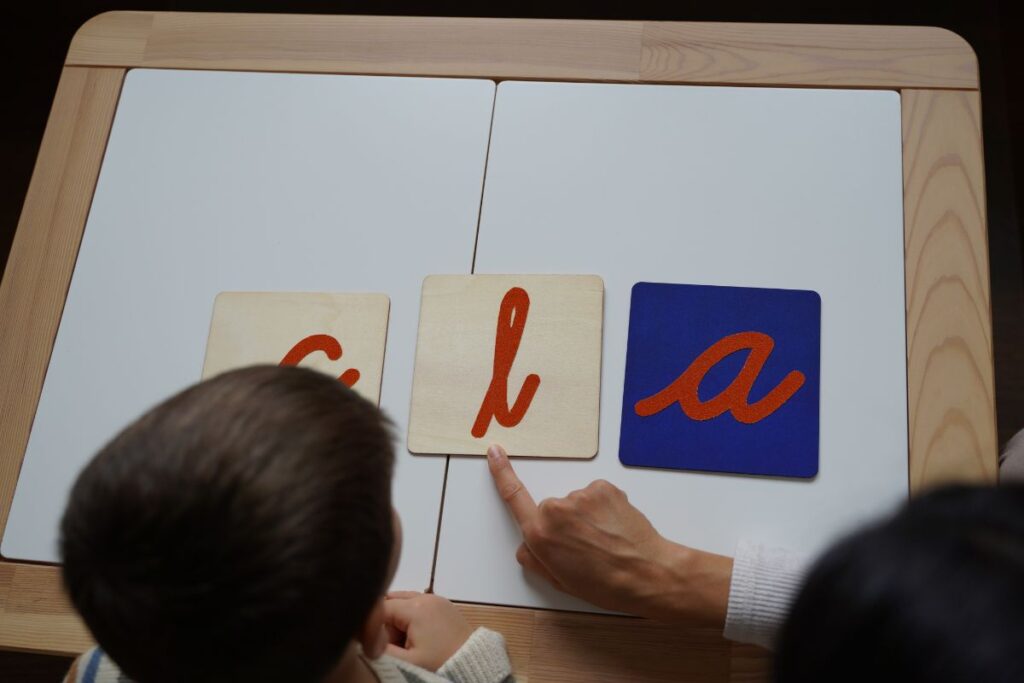
The purpose of Sandpaper Letters is to associate the sound of each letter with its respective symbol (what it looks like). As the child begins memorizing the sounds of each letter, they are also tracing them, not only preparing their mind but also their hand for writing!
Before introducing the Sandpaper Letters, I want to emphasize how important the spoken language is. The child’s work of writing and reading is built upon the foundation of spoken language. This is why it is so important to engage children in meaningful conversations. Asking them questions and getting to know their thoughts gives them the chance to improve their vocabulary.
After your child has had some practice with Spoken Language activities like the Sound Games (a.k.a. “I Spy”), then we can start introducing the Sandpaper Letters. The letters are NOT presented by their names, instead we teach them the sounds that they represent.
Why Cursive?
Great question, right? Who uses cursive anymore anyway!? Well, Maria Montessori recommended that we introduce cursive into writing for a reason. Besides the fact that it’s simply more beautiful, there are developmental reasons why cursive is the best choice for children ages 3 to 6:
- Cursive follows the natural circular movements of the hand. When you see a child with a crayon, they will first start to scribble and their hand will move in a circular pattern. Cursive follows this patter too. Print, on the other hand, requires a lot of stopping and starting and lifting the pencil up and down.
- When writing in cursive, it is very hard to accidentally write letters backwards. Each letter has a start and finish and they are linked in a continuous flow. This can be very useful for children with dysgraphia.
- Each letter has a clear beginning and end, making it easier for the child to connect and identify each of them.
- Children who learn cursive early, tend to have less problems identifying other types of calligraphy like print, gothic or script. However, for those who only learn print they find it more difficult reading cursive later.
- Brain scans show that cursive activates the left and right hemispheres of the brain, something that neither print or typing do. Many studies have also found that students that write in cursive perform generally better on essays and spelling tests.
In the classroom we also have Sandpaper Letters in print to help children transition from cursive to print. Nevertheless, children naturally make that connection when they start reading books or going about their everyday life since most things now are written in print.
How to Make DIY Montessori Sandpaper Letters
Materials:

- Sandpaper Letters Template (see links at bottom of post)
- 26 wood panels (15 cm x 15 cm or 6″ x 6″)
- 220 grit sandpaper sheets
- Scissors
- Exacto knife or utility knife
- Wood glue
- Paint brush
- Blue paint and pink paint (optional)
- Small paint roller (optional)
Age: 2 ½ to 4 years old
Instructions:
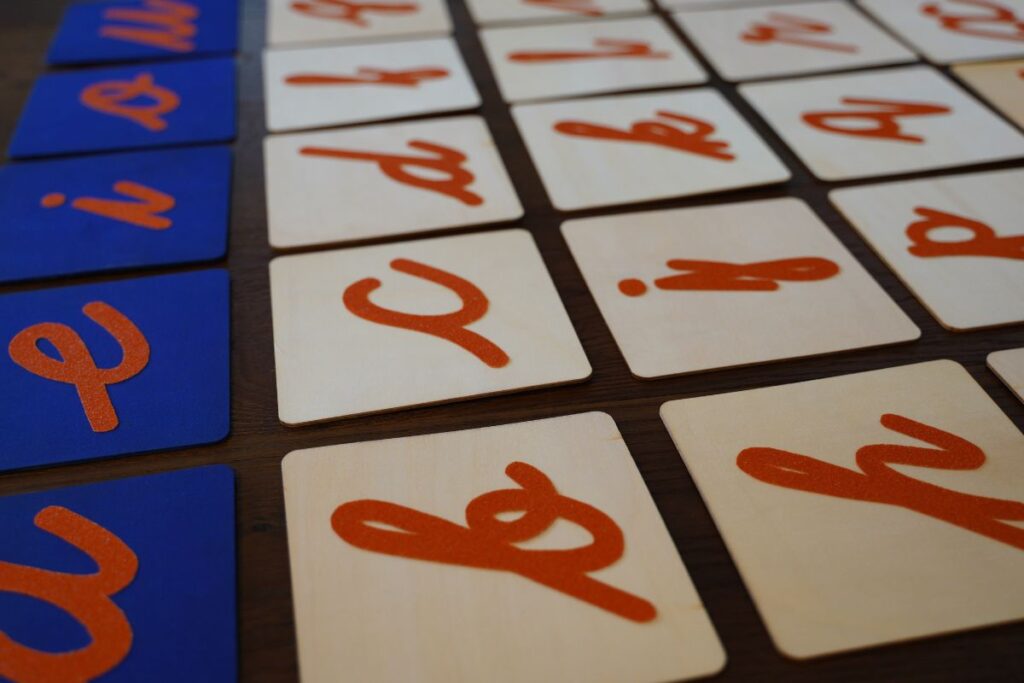
1. Paint 5 wood panels blue and the other 21 panels pink. Let them dry. The blue colored wood panels are for the vowels and the pink ones for consonants. This is optional, although I recommend to at least paint the blue panels for the vowels in order to differentiate them from the consonants. In my case, I decided to just paint the blue panels and leave the rest unpainted because the sandpaper I used was orange and I thought the letters would pop up more and look better without painting the wood.

2. Print the Sandpaper Letters Template (your preference of cursive or print) and cut each letter.

3. Place the cut-out letters backwards onto the smooth side of the sandpaper and trace them with a pencil.

4. Cut them all with an exacto knife or scissors.

5. Glue each Sandpaper Letter on the smooth side and place it into the center of each wood panel using the wood glue. Make sure to glue the vowels onto the blue panels and the consonants onto the rest.

You are done!

Conclusion
I hope you’ve learned a little about the importance of teaching the Sandpaper Letters to your child and are now excited to make them yourself! Making the Sandpaper Letters can be a lot of work but it is SO worth it and once you’ve made them you can use them for siblings too. It is a key material to start teaching your child to write and read. Not only that, but they will have a lot of fun while learning too!
Printables for Download
Sandpaper Letters Template
Sandpaper Letters Checklist

How to Make DIY Montessori Sandpaper Letters
In this tutorial you will learn how to make the Sandpaper Letters!This is a great Montessori material to start introducing the sounds of the letters to your child and to prepare their hand to learn the writing motions.
You will be making 5 vowels and 21 consonants of the English Alphabet in your choice of cursive or print. You will find the printable PDF below!
Target ages: 2 ½ to 4 years old.
Materials
Instructions
- Paint 5 wood panels blue and the other 21 panels pink. Let them dry.
- Print the Sandpaper Letters Template (your preference of cursive or print) and cut each letter.
- Place the cut-out template letters backwards onto the smooth side of the sandpaper. Remember, the letter needs to be backwards.
- Trace the letters with a pencil onto the smooth side of the sandpaper (the back side) and cut them all with an exacto knife or scissors.
- Glue each Sandpaper Letter on the smooth side and place it into the center of each wood panel using wood glue. Make sure to glue the vowels onto the blue panels and the consonants onto the rest. You are done!
Notes
The blue colored wood panels are for the vowels and the pink ones for consonants. This is optional, although I recommend to at least paint the blue panels for the vowels in order to differentiate them from the consonants. In my case, I decided to just paint the blue panels and leave the rest unpainted because the sandpaper I used was orange and I thought the letters would pop up more and look better without painting the wood.
Wood panels: I've got 50 of them on Amazon (link above) and I used them for both the Sandpaper Letters and the Sandpaper Numbers.
