
Bring Numbers to Life with Montessori Number Rods and Cards
Want to help your child truly understand numbers? In this Montessori lesson, they’ll match Number Rods to their corresponding numerals, turning counting into a concrete, meaningful experience. This activity strengthens number sense, reinforces counting skills, and gives children the joy of discovering how quantities and symbols connect.
Plus, at the end of the post, you can download a free PDF of numeral cards to bring this lesson to life at home or in the classroom!
Target ages: 4 to 4 ½ years old.
| Table of Contents |
| What is the Montessori Method? What is the Math Area in Montessori? The Mathematical Mind Quantity Before Symbol The Number Rods with Numerals Presentation Conclusion |
What is the Montessori Method?
The Montessori Method follows the child’s interests and needs. Maria Montessori created different areas in the classroom (Practical Life, Sensorial, Math and Language) with specific materials to teach children different skills that will help them in their everyday life.
If you think about a normal school, you would probably imagine a big chalkboard on the wall and all of the students sitting at their desk looking at the teacher. In a Montessori classroom this looks very different. The main difference between a Montessori school and a traditional one is that the teachers give one-on-one lessons, or very small group lessons, and follow the interest of each child. Individual lessons are a great way for teachers to get to know the children and their needs. We use tangible materials that are built to teach specific skills, perfect to catch the attention of the little ones since they are using their hands. Maria Montessori once said: “Movement of the hand is essential. Little children revealed that the development of the mind is stimulated by the movement of the hands. The hand is the instrument of the intelligence”.
In the Montessori classroom, children are also allowed to walk freely in their environment and choose the work they want to do that has been previously presented by the teacher. Seeing children walking around the classroom like this can look a little messy at times, but I like to call it “organized chaos”. Children have a lot of freedom but within set boundaries.
The Montessori Method has been such a big eye opener for me in the way I want to teach and educate my children. I hope it inspires you too!
What is the Math Area in Montessori?
Since mathematics can be a challenging subject for young children, Maria Montessori transformed abstract concepts into concrete materials that children could see, touch, and manipulate.
Through her carefully designed lessons, children explore numbers from 0 to 10, the decimal system, the four operations (addition, subtraction, multiplication, and division), fractions, and much more—all before the age of six! The fact that such young children can grasp these complex ideas speaks to the brilliance of the materials she created.
Maria Montessori often said that “the hand is the instrument of the mind”, emphasizing her belief that learning happens through purposeful, hands-on experience.
The Mathematical Mind
Whenever you are crossing the street, buy something at a store, scheduling your time or measuring ingredients to make a meal, you are using your mathematical mind. Mathematics is not just found in books but in the world that surrounds us. Maria Montessori said that our mind is mathematical by nature. We are all born with a mathematical mind that have the following abilities:
- Curiosity and interest, which leads to investigation.
- An awareness of the world that leads us to observe everything around us.
- The ability to reason and make judgements.
- The ability to make order out of chaos.
- Organize and classify information.
- The ability to complete a task through repetition, exactitude and precision.
Screens and technology have put to sleep a lot of this innate abilities that we are born with. We should be conscious on how we use them with our children so that we make sure their spark for investigation, exploration and curiosity is still there!
Quantity Before Symbol
It is not uncommon for children to know the name of the numbers by memory, but that does not mean they understand the quantity that is associated with those numbers.
Maria Montessori prepared different materials to understand this abstract concept of numbers to children. The first lesson she created for this was the Number Rods. The Number Rods introduce children to the quantity of each number (e.g.: “two is a bigger quantity than one”) in a concrete and tactile way. After this, we will teach the Sandpaper Numbers (symbol) for our children to learn what every number looks like. The materials that follow after that will reinforce the learning of the quantity and symbol together (like the Number Rods with Numerals, Spindle Boxes, Cards and Counters or the Memory Game of Numbers).
When we teach the numbers to our children in this way, we create a strong foundation for more complicated and abstract math in the future.
The Number Rods with Numerals Presentation
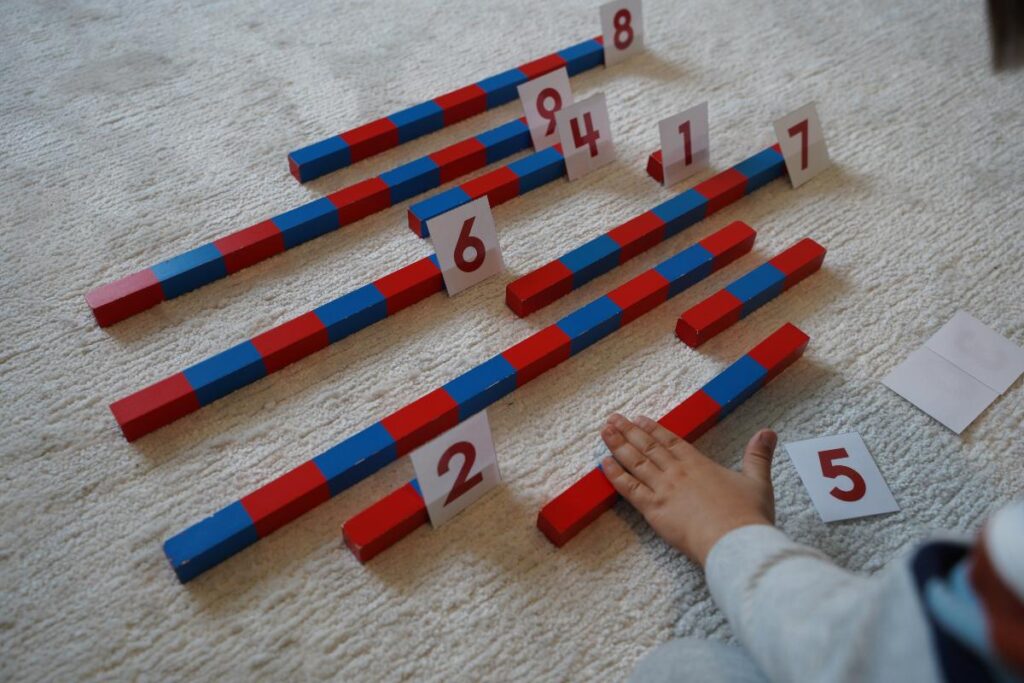
Preparation: Your child has worked previously with the Number Rods and recognizes all of the Sandpaper Numbers
Materials:
- The Number Rods
- Numeral Cards Printable (numbers 1 to 10)
Age: 4 to 4 ½ years old
Presentation:
- Go to the shelf and bring all of the Number Rods one by one with your child and place them randomly on a carpet.
- Come back to the shelf and ask your child to bring the little box with the numeral cards.
- Sit at the carpet.
- Open the box and take the numbers out.
- Ask your child to say the name of all the numbers as you take them out to see if he recognizes them.
- Place the numbers randomly one by one on the carpet while the child is naming them.
- When done, pile the numbers facing down.
- Take one number and invite your child to place it in the correspondent rod: “Which number is this? Do you see the number rod for that number?”
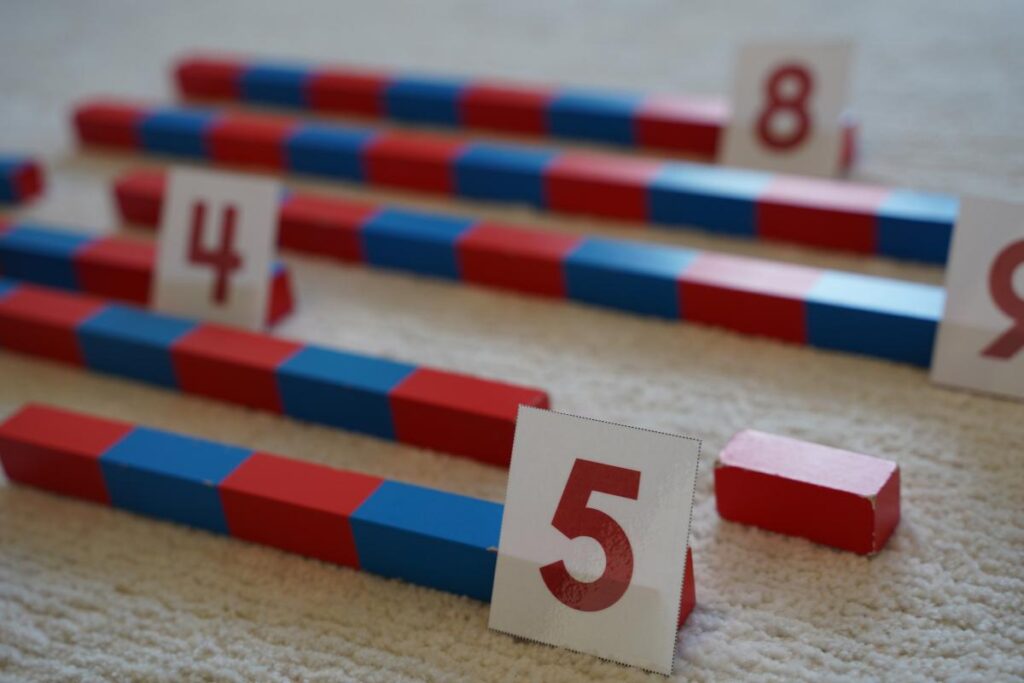
- Invite your child to place the number on the rod, putting the numbers at the end of each rod.
- Encourage them to count the number rods to make sure they are putting the number in the correct rod.
- Show your child how to do it with the first number and then invite them to do the rest of the numbers independently.
- Fade and observe.
- When done, you can come back and encourage them to do this exercise as many times as they want.
Note: We are going to also pull out of the box number 10. If your child doesn’t know it, we will just tell them.
Conclusion
The Number Rods with Numerals is great lesson for your child to associate concrete quantities with the written symbol. It is also a great way for them to practice counting. You can download the Numeral Cards here and start teaching your child today!
Affiliate Disclaimer: Some links on this site are affiliate links. If you make a purchase, I may earn a small commission at no extra cost to you. As an Amazon Associate, I earn from qualifying purchases. I only share products I truly recommend.
