
Montessori Spindle Boxes: Master Number Sequences and the Value of Zero
Have you ever watched a child count objects one by one with their little fingers carefully keeping track? The Montessori Spindle Boxes build on that natural curiosity. This beautiful material helps children connect the written symbol of a number with the real quantity it represents. As they count and place spindles into each section, they discover what numbers truly mean—including the powerful idea of zero.
Target ages: 4 to 4 ½ years old.
| Table of Contents |
| What is the Montessori Method? What is the Math Area in Montessori? The Mathematical Mind Quantity Before Symbol Spindle Boxes Presentation Conclusion |
What is the Montessori Method?
The Montessori Method follows the child’s interests and needs. Maria Montessori created different areas in the classroom (Practical Life, Sensorial, Math and Language) with specific materials to teach children different skills that will help them in their everyday life.
If you think about a normal school, you would probably imagine a big chalkboard on the wall and all of the students sitting at their desk looking at the teacher. In a Montessori classroom this looks very different. The main difference between a Montessori school and a traditional one is that the teachers give one-on-one lessons, or very small group lessons, and follow the interest of each child. Individual lessons are a great way for teachers to get to know the children and their needs. We use tangible materials that are built to teach specific skills, perfect to catch the attention of the little ones since they are using their hands. Maria Montessori once said: “Movement of the hand is essential. Little children revealed that the development of the mind is stimulated by the movement of the hands. The hand is the instrument of the intelligence”.
In the Montessori classroom, children are also allowed to walk freely in their environment and choose the work they want to do that has been previously presented by the teacher. Seeing children walking around the classroom like this can look a little messy at times, but I like to call it “organized chaos”. Children have a lot of freedom but within set boundaries.
The Montessori Method has been such a big eye opener for me in the way I want to teach and educate my children. I hope it inspires you too!
What is the Math Area in Montessori?
Since mathematics can be a challenging subject for young children, Maria Montessori transformed abstract concepts into concrete materials that children could see, touch, and manipulate.
Through her carefully designed lessons, children explore numbers from 0 to 10, the decimal system, the four operations (addition, subtraction, multiplication, and division), fractions, and much more—all before the age of six! The fact that such young children can grasp these complex ideas speaks to the brilliance of the materials she created.
Maria Montessori often said that “the hand is the instrument of the mind”, emphasizing her belief that learning happens through purposeful, hands-on experience.
The Mathematical Mind
Whenever you are crossing the street, buy something at a store, scheduling your time or measuring ingredients to make a meal, you are using your mathematical mind. Mathematics is not just found in books but in the world that surrounds us. Maria Montessori said that our mind is mathematical by nature. We are all born with a mathematical mind that have the following abilities:
- Curiosity and interest, which leads to investigation.
- An awareness of the world that leads us to observe everything around us.
- The ability to reason and make judgements.
- The ability to make order out of chaos.
- Organize and classify information.
- The ability to complete a task through repetition, exactitude and precision.
Screens and technology have put to sleep a lot of this innate abilities that we are born with. We should be conscious on how we use them with our children so that we make sure their spark for investigation, exploration and curiosity is still there!
Quantity Before Symbol
It is not uncommon for children to know the name of the numbers by memory, but that does not mean they understand the quantity that is associated with those numbers.
Maria Montessori prepared different materials to understand this abstract concept of numbers to children. The first lesson she created for this was the Number Rods. The Number Rods introduce children to the quantity of each number (e.g.: “two is a bigger quantity than one”) in a concrete and tactile way. After this, we will teach the Sandpaper Numbers (symbol) for our children to learn what every number looks like. The materials that follow after that will reinforce the learning of the quantity and symbol together (like the Number Rods with Numerals, Spindle Boxes, Cards and Counters or the Memory Game of Numbers).
When we teach the numbers to our children in this way, we create a strong foundation for more complicated and abstract math in the future.
Spindle Boxes Presentation

Preparation: Your child has worked previously with Number Rods with Numerals
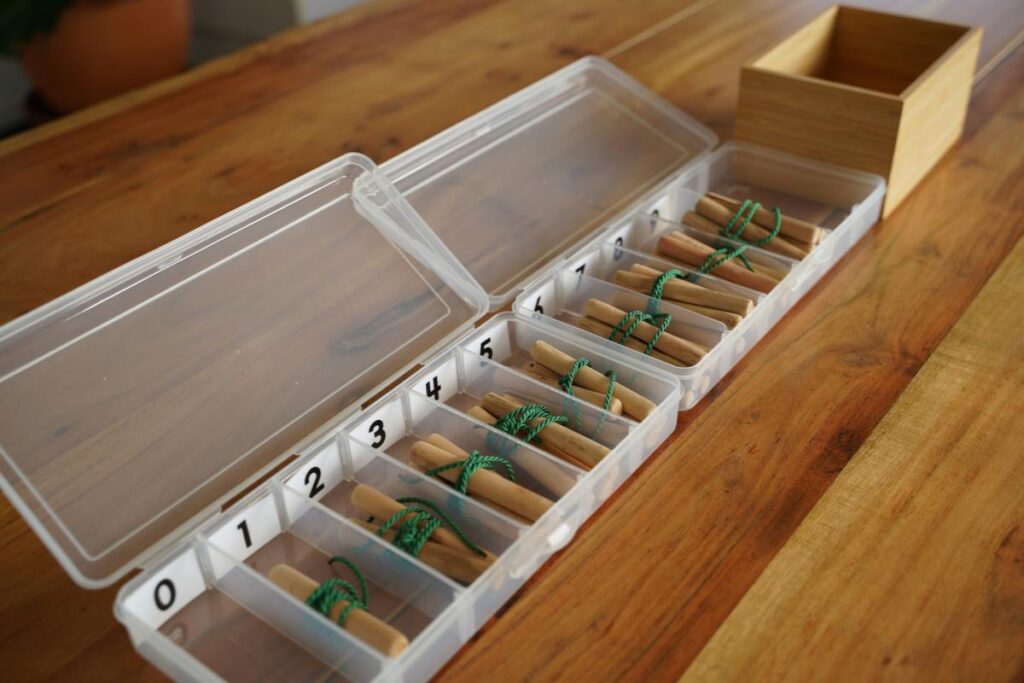
Materials: DIY Montessori Spindle Boxes
Age: 4 to 4 ½ years old
Presentation:
- Introduce the new material to your child: “These are the Spindle Boxes, let’s carry them to the table”.
- Sit at the table.
- Show your child the spindles or sticks: “These are called spindles, they are going to help us count!”
- Point to the numbers (1 – 9) in the Spindle Boxes and invite your child to name them. Don’t point to number 0 yet.
- After this, introduce number 0 for the first time to your child: “This is number 0”.
- Next, say: “I am going to show you something”.
- Place a ribbon horizontally in front of you.
- Point and name number 1 on the Spindle Box.
- Get one spindle from the box, and count it out loud holding it with one hand.
- Take the ribbon and place it around the spindle.*
- Place the spindle in the space for number 1, inside the box.
- Repeat the process with the rest of the numbers (2 to 9).
- When done, point to the child: “Look, there are no more spindles or ribbons! We used them all!”
- Also, point to the child that number 0 didn’t get any spindles: “Zero is empty; we are not going to put anything in it”.
Show your child how to put the Spindles away:
- Point to number 1 and name it out loud.
- Untie the ribbon that is around the spindle.
- Put the ribbon back in the basket.
- Put the spindle back in the original box, counting the number of spindles we are putting back out loud.
- Do this with the rest of the numbers.
- When done, invite your child to do this exercise independently: “You can now count the spindles and put them in the Spindle Boxes as many times as you like”.
- Fade and observe.

Notes:
- *To make it easier for children to tie the ribbon around the spindles, I like to do a little loop on one end of each ribbon with a knot. This way, children will just have to put the loop through one of the spindles and then just rap it around the rest to hold them together.
- Tying the spindles with each ribbon gives children the sensation of each number as a whole.
- Counting the spindles into one’s open hand, allows children to feel the difference in quantity as the numbers get bigger.
- This exercise introduces children to the concept of “0” for the first time. When referring to the compartment of “0”, be careful not to say: “Zero is nothing”. Zero is a very important element in our number system. Instead we can say: “Zero is empty” or “We don’t put anything in zero”.
- We can now return to the Sandpaper Numbers and introduce number ‘”0″. Although we can introduce “0” at any point if the child asks about it.
- If your child is struggling to use the ribbons to bundle the spindles, you can give a separate lesson at another time on how to manipulate the ties.
Conclusion
Even with simple materials, we can help children grasp big concepts like numbers. While Number Rods introduced fixed quantities, Spindle Boxes allow children to create their own sets using individual spindles, making learning more hands-on and concrete. This activity also provides a natural first introduction to the concept of zero.
With each Montessori math material, children deepen their understanding of numbers, building a solid foundation that prepares them for more complex mathematical concepts in the future. Through these experiences, learning becomes both meaningful and joyful.
