
How to Introduce New Vocabulary: The Three Period Lesson
The Three Period Lesson is a fun and effective Montessori lesson to introduce new vocabulary to children. You can use it in any scenario whenever your child encounters new words. It is a very productive, clear and straightforward technique that’s entertaining for children!
Target ages: 2 and up.

| Table of Contents |
| What is the Montessori Method? The Language Area in the Montessori Classroom The Sensitive Period for Language What is the Three Period Lesson? Example of a Three Period Lesson Conclusion |
What is the Montessori Method?
The Montessori Method follows the child’s interests and needs. Maria Montessori created different areas in the classroom (Practical Life, Sensorial, Math and Language) with specific materials to teach children different skills that will help them in their everyday life.
If you think about a normal school, you would probably imagine a big chalkboard on the wall and all of the students sitting at their desk looking at the teacher. In a Montessori classroom this looks very different. The main difference between a Montessori school and a traditional one is that the teachers give one-on-one lessons, or very small group lessons, and follow the interest of each child. Individual lessons are a great way for teachers to get to know the children and their needs. We use tangible materials that are built to teach specific skills, perfect to catch the attention of the little ones since they are using their hands. Maria Montessori once said: “Movement of the hand is essential. Little children revealed that the development of the mind is stimulated by the movement of the hands. The hand is the instrument of the intelligence”.
In the Montessori classroom, children are also allowed to walk freely in their environment and choose the work they want to do that has been previously presented by the teacher. Seeing children walking around the classroom like this can look a little messy at times, but I like to call it “organized chaos”. Children have a lot of freedom but within set boundaries.
The Montessori Method has been such a big eye opener for me in the way I want to teach and educate my children. I hope it inspires you too!
The Language Area in the Montessori Classroom
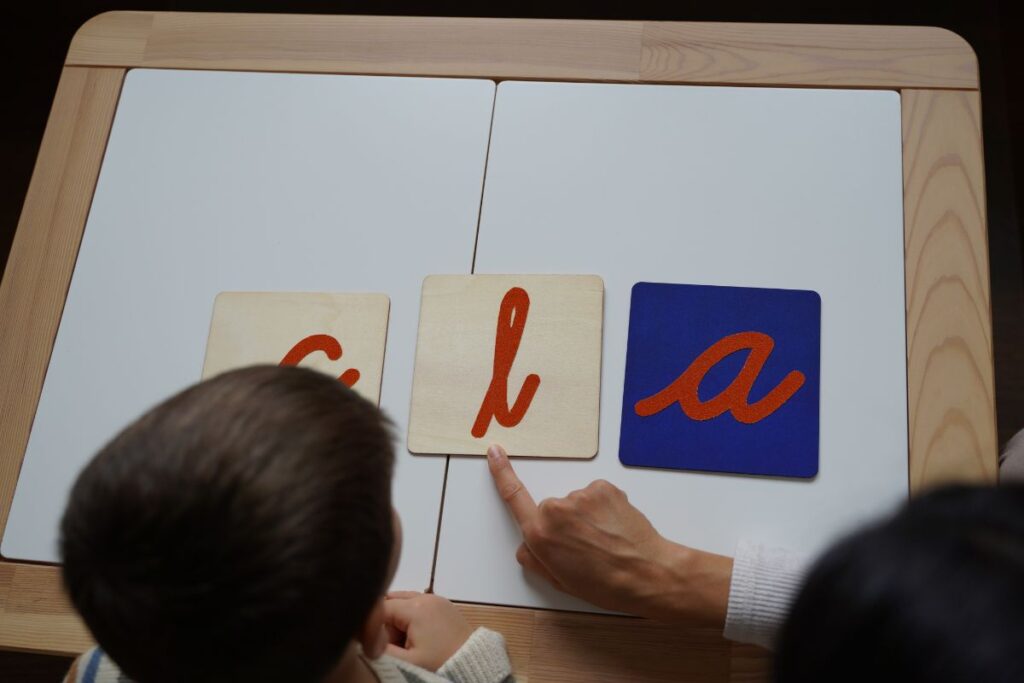
When Maria Montessori started teaching children, she had no plans to add a Language area in the classroom. She would tell stories to the children, engage them in conversations and did Three Period Lessons to teach them new vocabulary, but her goal wasn’t to teach them to write or to read. But the parents of those children were illiterate and begged Maria Montessori to teach their children to read. After a lot of observations, the first set of language materials was made!
In the language area, children progress from spoken language exercises to the written language where they use tangible materials (Sandpaper Letters, Movable Alphabet, Metal Insets, etc.) to raise awareness of the sounds that make up each word. Children then move to reading exercises where they learn to decode words and, eventually, sentences. Finally, grammar exercises teach children the function that different words have in a sentence. All of this is possible at such young age because of the hands-on materials Maria Montessori prepared!
The Sensitive Period for Language
Did you notice how easily children learn new vocabulary? They seem to pick up the language simply by being around it! Children 0 to 6 years old are experiencing what Maria Montessori called the “Sensitive Period for Language”. This means that there will never be a time in your child’s life where it will be so easy for them to assimilate language. We need to take full advantage of this and provide them with the necessary tools to maximize their learning.
What is the Three Period Lesson?
The Three Period Lesson introduces new vocabulary to children and is divided into three different parts:
Period 1: Naming

To introduce this lesson, choose two or three things your child doesn’t know. This has to be some kind of object or picture card that you can handle and use during the lesson. You then name them for your child with a very clear pronunciation.
Period 2: Recognition

This is the longest and most important of the three periods. It engages your child’s mind and hands. You can make it fun and like a game for them.
You are going to give them different commands in relation to the objects or picture cards they don’t know (example with picture cards: “give me Italy”, “place Switzerland on your knee”, “point to United Kingdom”). With each command your child will have something to do with that object or picture. During this period, you will be providing the vocabulary and your child is asked to recognize it. If they respond incorrectly, don’t correct them but just keep giving them commands.
Period 3: Recall
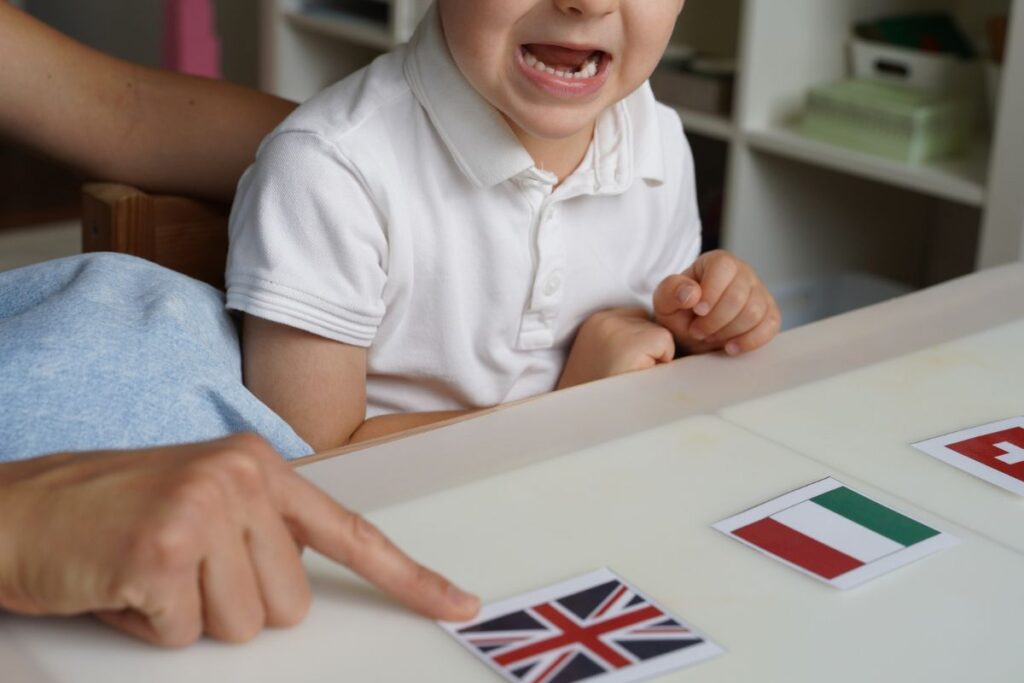
Once you see your child is comfortable with the new vocabulary and responds well to the commands, you will introduce this “Recall” period. This is like a test to your child, proving their ability to recall the new words. You will simply point at the object or card and ask: “What is this?” Calling words is more difficult than recognizing them. If your child can’t remember the words or makes a mistake, don’t point it out, just go back to Period 1 or 2 to practice more. I do not recommend introducing more than 6 new vocabulary words a day.
Example of a Three Period Lesson
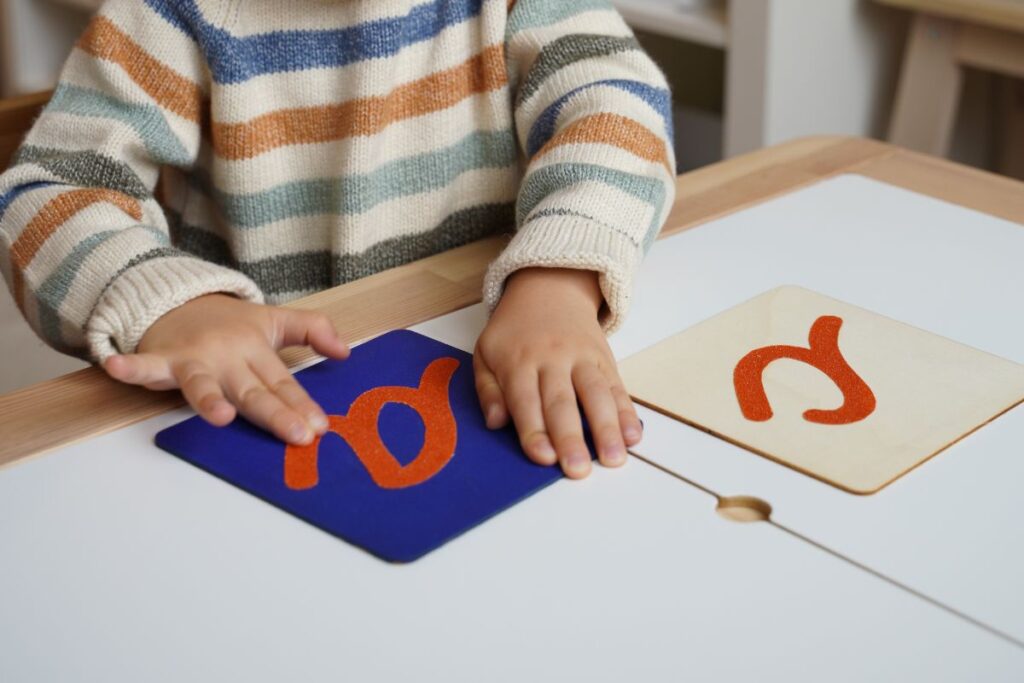
For the next example, we will pretend we are teaching three different sounds in the Sandpaper Letters that your child doesn’t know yet.
Presentation
- Present the Sandpaper Letters “c”, “l” and “a” to your child following the Sandpaper Letters presentation.
- When done, put the letters facing up on the center of the table.
- Do a 3 Period Lesson:
- Naming:
- Point to letter “c” and say the sound: “|c|”
- Point to letter “l” and say the sound: “|l|”
- Point to letter “a” and say the sound: “|a|”
- Recognition:
- Give the child several commands: “Trace |a|”, “give me |l|”, “place |c| on your lap”.
- Point to a spot on the table and say: “Place |c| here”, “Place |a| here”, “Place |l| here”.
- Continue: “Take |l| and put it on my hand”, “Trace |c|”, “Place |a| on my nose”, “Point to |c|”, “Take |l| and put it back on the table”, “Give me |c|”, “Trace |a|”, “Place |a| next to |l|”, “Place |c| on your head”, etc.
- Recall:
- Point to letter “l” and say: “What is this?” (The child will say the sound of the letter)
- Point to letter “a” and say: “What is this?” (The child will say the sound of the letter)
- Point to letter “c” and say: “What is this?” (The child will say the sound of the letter)
- Naming:
- Close the activity: “You can now trace these Sandpaper Letters as many times as you want. When you are done you can put them back on the shelf“.
- Fade and observe.
Conclusion
The Three Period Lesson is a great way to teach children new vocabulary. Your children won’t even notice that you are giving them a lesson because it always seems like a game to them! I’ve used Three Period Lessons to teach the name of the numbers, letters, animals, objects in general… it really can be use for ANY new word your child needs or wants to learn! I would love to hear from you if you have any questions or even to share what words you have taught your child with this technique. Feel free to leave a comment and stay connected!
How to Introduce New Vocabulary: The Three Period Lesson
The Three Period Lesson is a fun and effective Montessori lesson to introduce new vocabulary to children. You can use it in any scenario whenever your child encounters new words. It is a very productive, clear and straightforward technique that's entertaining for children!
Target ages: 2 and up.
Materials
- Choose 2 or 3 things your child doesn't know the name of. This has to be some kind of object or picture card that you can handle and use during the lesson.
Instructions
For this example I will pretend we are teaching our child 3 picture cards of the flags of Italy, Switzerland and United Kingdom.
Period 1: Naming
Place the 3 cards on the table. Point at them, one at a time, and name them for your child: "This Italy", "this is Switzerland", "this is United Kingdom".
Period 2: Recognition
This is the longest and most important of the three periods. It engages your child's mind and hands.
You are going to give them differentcommands in relation to the picture cards. With each command your child will have something to do with the cards. You will ask things like: "give me Italy", "place Switzerland on your knee", "point to United Kingdom", "stand next to Switzerland", "place Italy on your head", "touch United Kingdom", "hug Italy".
During this period, you are providing the vocabulary and your child is asked to recognize it. If they respond to a command incorrectly, don't correct them but just keep giving them commands. Make sure to make it fun!
Period 3: Recall
Once you see your child is comfortable with the new vocabulary and responds well to the commands, you will introduce this "Recall" period.
This is like a test to your child, proving their ability to recall the new words. You will simply point at each card and ask: "What is this?"
Calling words is more difficult than recognizing them. If your child can't remember the words or makes a mistake, don't point it out, just go back to Period 1 or 2 to practice more. I do not recommend introducing more than 6 new vocabulary words a day.
Notes
Check out my blog to download free picture cards to teach new vocabulary to your child today!
