
The Montessori Movable Alphabet: A Child’s First Steps Towards Writing
The Montessori Movable Alphabet is designed to bridge the gap between spoken and written language. It allows children to construct words and sentences even before they can write by hand. Through this hands-on exploration, children build confidence, strengthen their phonetic awareness and start to develop a real love for writing.
To support your child’s journey, we’ve included a free printable Letter Record Card below. It’s designed to help you track which Sandpaper Letters your child has mastered, making it easy to know when they’re ready to begin forming words with the Movable Alphabet.
Target ages: 4 and up
| Table of Contents |
| What is the Montessori Method? The Language Area in the Montessori Classroom Writing Before Reading Why Cursive? The Movable Alphabet Presentation Conclusion |
What is the Montessori Method?
The Montessori Method follows the child’s interests and needs. Maria Montessori created different areas in the classroom (Practical Life, Sensorial, Math and Language) with specific materials to teach children different skills that will help them in their everyday life.
If you think about a normal school, you would probably imagine a big chalkboard on the wall and all of the students sitting at their desk looking at the teacher. In a Montessori classroom this looks very different. The main difference between a Montessori school and a traditional one is that the teachers give one-on-one lessons, or very small group lessons, and follow the interest of each child. Individual lessons are a great way for teachers to get to know the children and their needs. We use tangible materials that are built to teach specific skills, perfect to catch the attention of the little ones since they are using their hands. Maria Montessori once said: “Movement of the hand is essential. Little children revealed that the development of the mind is stimulated by the movement of the hands. The hand is the instrument of the intelligence”.
In the Montessori classroom, children are also allowed to walk freely in their environment and choose the work they want to do that has been previously presented by the teacher. Seeing children walking around the classroom like this can look a little messy at times, but I like to call it “organized chaos”. Children have a lot of freedom but within set boundaries.
The Montessori Method has been such a big eye opener for me in the way I want to teach and educate my children. I hope it inspires you too!
The Language Area in the Montessori Classroom
When Maria Montessori started teaching children, she had no plans to add a Language area in the classroom. She would tell stories to the children, engage them in conversations and did Three Period Lessons to teach them new vocabulary, but her goal wasn’t to teach them to write or to read. But the parents of those children were illiterate and begged Maria Montessori to teach their children to read. After a lot of observations, the first set of language materials was made!
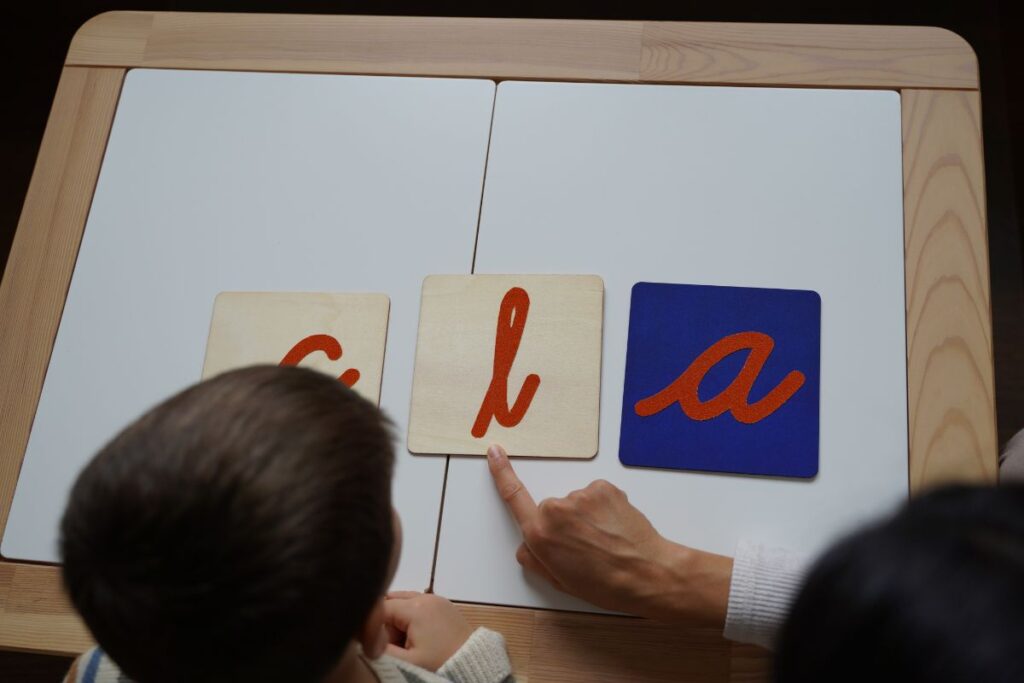
In the language area, children progress from spoken language exercises to the written language where they use tangible materials (Sandpaper Letters, Movable Alphabet, Metal Insets, etc.) to raise awareness of the sounds that make up each word. Children then move to reading exercises where they learn to decode words and, eventually, sentences. Finally, grammar exercises teach children the function that different words have in a sentence. All of this is possible at such young age because of the hands-on materials Maria Montessori prepared!
Writing Before Reading
One of the most fascinating aspects of Montessori education is that children learn to write before they learn to read. At first, this may seem backward—after all, in most traditional settings, reading usually comes first. But Maria Montessori observed that children naturally want to express themselves long before they’re ready to decode the words others have written.
Using the Movable Alphabet, children begin to build words with letters that represent the sounds they hear in speech. They don’t need to know how to read those words yet; they are simply translating the sounds in their head into written form through the alphabet pieces. For example, when a child wants to “write” cat, they listen carefully for each sound—/c/, /a/, /t/—and find the letters that match.
This process is deeply empowering. Instead of passively memorizing, children are actively creating language. Over time, as they continue to build words and short sentences, they start to recognize those same patterns when reading. In other words, writing opens the door to reading—naturally, joyfully, and without pressure.
In the Montessori environment, writing is the bridge between spoken language and reading. It’s a gentle, hands-on journey that allows children to discover literacy from the inside out—led by curiosity, not instruction.
Why Cursive?
Great question, right? Who uses cursive anymore anyway? Well, Maria Montessori recommended that we introduce cursive into writing for a reason. Besides the fact that it’s simply more beautiful, there are developmental reasons why cursive is the best choice for children ages 3 to 6:
- Cursive follows the natural circular movements of the hand. When you see a child with a crayon, they will first start to scribble and their hand will move in a circular pattern. Cursive follows this patter too. Print, on the other hand, requires a lot of stopping and starting and lifting the pencil up and down.
- When writing in cursive, it is very hard to accidentally write letters backwards. Each letter has a start and finish and they are linked in a continuous flow. This can be very useful for children with dysgraphia.
- Each letter has a clear beginning and end, making it easier for the child to connect and identify each of them.
- Children who learn cursive early, tend to have less problems identifying other types of calligraphy like print, gothic or script. However, for those who only learn print they find it more difficult reading cursive later.
- Brain scans show that cursive activates the left and right hemispheres of the brain, something that neither print or typing do. Many studies have also found that students that write in cursive perform generally better on essays and spelling tests.
In the classroom we also have Sandpaper Letters in print to help children transition from cursive to print. Nevertheless, children naturally make that connection when they start reading books or going about their everyday life since most things now are written in print.
The Movable Alphabet Presentation
The Movable Alphabet is very exciting presentation, it will be the first time your child writes! It’s amazing to watch how they begin to sound out the words in their mind and discover that their own thoughts can be represented with letters.
After you present this lesson, encourage your child to use the Movable Alphabet as often as they can. With regular practice, you’ll be surprised at how quickly their confidence and skills grow.
You can also download our free printable Letter Record Card to use alongside the Movable Alphabet. It helps you keep track of which Sandpaper Letters your child has mastered and, in turn, which letters they’re ready to start writing with the Movable Alphabet. You can choose between a home version and a classroom version.
Materials

- Free printable tracking sheet (for home and for classrooms).
- Movable Alphabet
- Writing mat
Preparation Exercise

- Invite your child to the rug with the Movable Alphabet box and the Letter Record Card to review the sounds they already know.
- Sit together and open the box. Say: “In this box, we have all the letters of the alphabet, some of these you already know!”
- Take out one familiar letter and place it on the rug. Ask: “Do you remember this letter? What sound does it make?”
- Continue with the other known letters, following your child’s pace.
- When you’re finished, show your child how to return the letters neatly to their compartments.
Presentation: Writing Words with the Movable Alphabet

Once your child recognizes several sounds, you can introduce the first writing activity.
- Say: “We can use these letters to write words! I’m going to write some words now.”
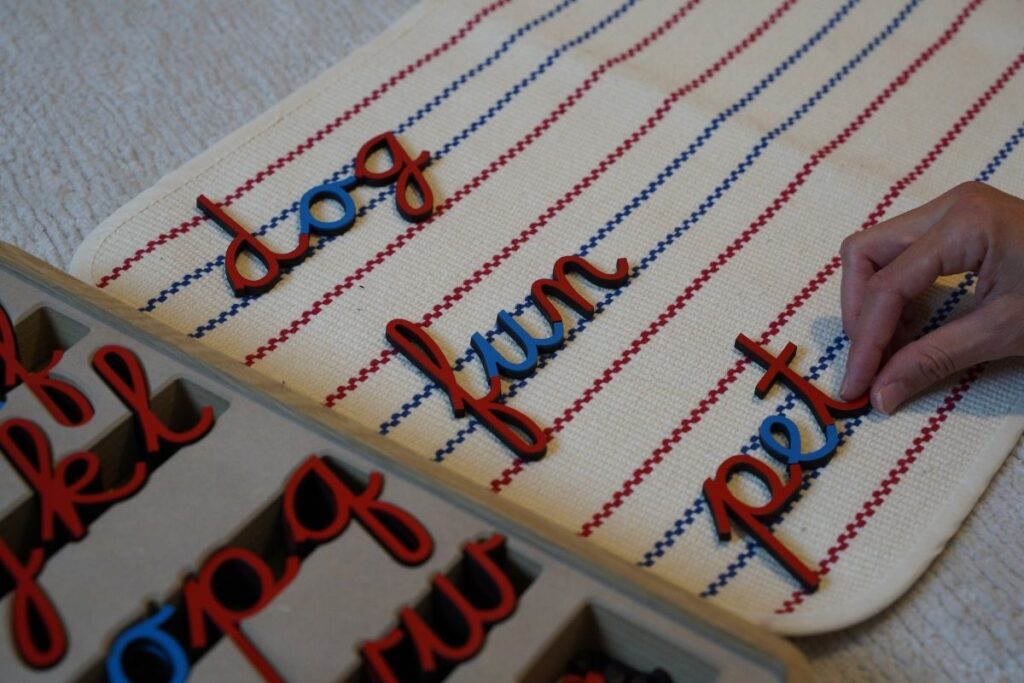
- Choose short, phonetic words such as dog, fun, pet, or frog.
- Introduce these words with a sentence. For example: “Let’s see… I think I’ll write dog, since I have a dog at home. Listen: dog — /d/… /o/… /g/.”
- Find each letter as you pronounce its sound and place it on the rug writing “dog”.
- Continue with a few more examples, always placing the word in a simple sentence:
- “My dog is really fun. Fun — /f/… /u/… /n/.”
- “My dog is my favorite pet. Pet — /p/… /e/… /t/.”
- “I really love my dog, but I wish I had a frog. Frog — /f/… /r/… /o/… /g/.”
- Three to four phonetic words are enough for the first lesson.
- When finished, clean up your letters and invite your child to write the words independently: “Would you like to write dog? What sounds do you hear when you say dog?”
- Observe quietly and step in only if your child needs support.
- When done, help your child return the letters neatly to the box.
Notes:
- We do not correct spelling at this stage. The goal is exploration, not perfection.
- It’s fine to gently correct if a letter is reversed or placed upside down.
- We do not ask the child to read the words they’ve written. The Movable Alphabet is a writing exercise, reading uses a different mental process.
- When we first show our child the Movable Alphabet, we are providing the words for them to write. Later, we want them to think of their own words so they are recording their own thoughts graphically.
- We always introduce each word within the context of a sentence before isolating it for writing. This helps our child connect spoken language (thoughts and sentences) to written expression.
Following Exercises
- Writing Their Own Words: Encourage your child to think of their own words. It doesn’t matter if a word is complicated, simply support their curiosity. If your child is unsure of a sound, just show it using the Movable Alphabet. Later, you can revisit that sound with the corresponding Sandpaper Letter or phonogram.
- Naming Objects: Invite your child to collect small objects and place them on the rug. They can then use the Movable Alphabet to write each name next to its object.
- Making a List: Children love making lists! They might list their friends, animals, toys, foods, or anything that excites them. Lists provide a joyful and natural way to practice phonetic spelling.
Conclusion
The Montessori Movable Alphabet invites children to play with language, experiment with sounds, and experience that thrilling moment when their ideas come alive in written form. Encourage them to explore it often, you’ll be amazed at how quickly their confidence grows!
Get started today with our free printable Letter Record Card to track their progress at home or in the classroom.
Affiliate Disclaimer: Some links on this site are affiliate links. If you make a purchase, I may earn a small commission at no extra cost to you. As an Amazon Associate, I earn from qualifying purchases. I only share products I truly recommend.
