
5 Montessori Activities That Will Help Children Gain New Vocabulary
If your child is six years old or younger, they’re in the Sensitive Period for Language, a magical time when their ability to absorb new words and expressions is at its peak! You won’t want to miss these five Montessori activities that help children build vocabulary, strengthen language skills, and have fun at the same time. The best part? They require little to no materials!
Target ages: 2 ½ and up.
| Table of Contents |
| What is the Montessori Method? The Language Area in the Montessori Classroom The Sensitive Period for Language 5 Spoken Language Montessori Activities Conclusion |
What is the Montessori Method?
The Montessori Method follows the child’s interests and needs. Maria Montessori created different areas in the classroom (Practical Life, Sensorial, Math and Language) with specific materials to teach children different skills that will help them in their everyday life.
If you think about a normal school, you would probably imagine a big chalkboard on the wall and all of the students sitting at their desk looking at the teacher. In a Montessori classroom this looks very different. The main difference between a Montessori school and a traditional one is that the teachers give one-on-one lessons, or very small group lessons, and follow the interest of each child. Individual lessons are a great way for teachers to get to know the children and their needs. We use tangible materials that are built to teach specific skills, perfect to catch the attention of the little ones since they are using their hands. Maria Montessori once said: “Movement of the hand is essential. Little children revealed that the development of the mind is stimulated by the movement of the hands. The hand is the instrument of the intelligence”.
In the Montessori classroom, children are also allowed to walk freely in their environment and choose the work they want to do that has been previously presented by the teacher. Seeing children walking around the classroom like this can look a little messy at times, but I like to call it “organized chaos”. Children have a lot of freedom but within set boundaries.
The Montessori Method has been such a big eye opener for me in the way I want to teach and educate my children. I hope it inspires you too!
The Language Area in the Montessori Classroom
When Maria Montessori started teaching children, she had no plans to add a Language area in the classroom. She would tell stories to the children, engage them in conversations and did Three Period Lessons to teach them new vocabulary, but her goal wasn’t to teach them to write or to read. But the parents of those children were illiterate and begged Maria Montessori to teach their children to read. After a lot of observations, the first set of language materials was made!
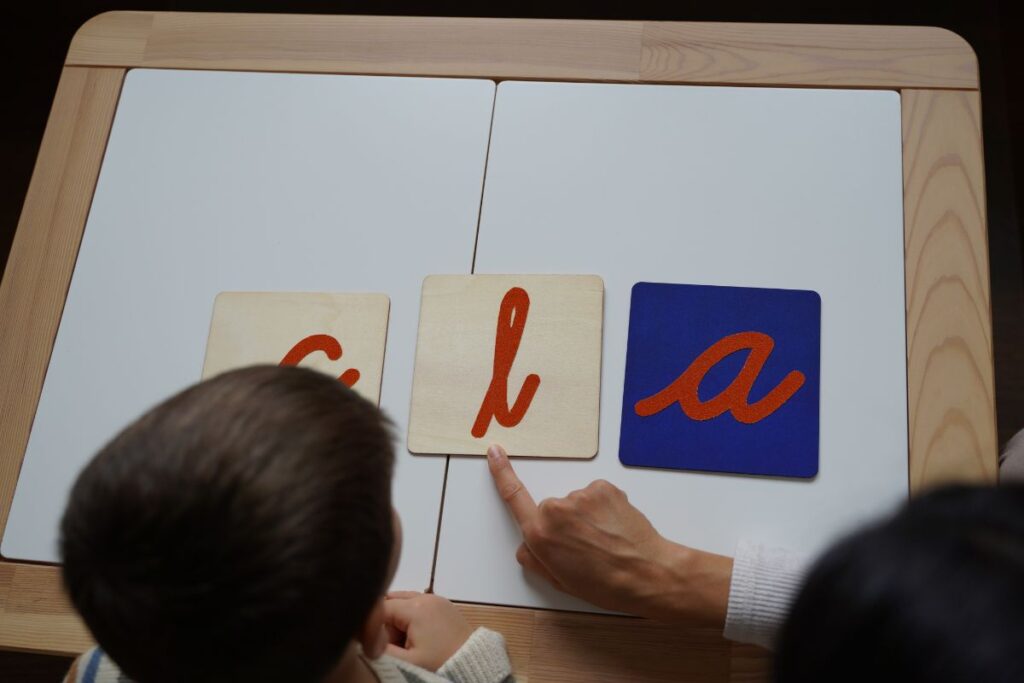
In the language area, children progress from spoken language exercises to the written language where they use tangible materials (Sandpaper Letters, Movable Alphabet, Metal Insets, etc.) to raise awareness of the sounds that make up each word. Children then move to reading exercises where they learn to decode words and, eventually, sentences. Finally, grammar exercises teach children the function that different words have in a sentence. All of this is possible at such young age because of the hands-on materials Maria Montessori prepared!
The Sensitive Period for Language
Did you notice how easily children learn new vocabulary? They seem to pick up the language simply by being around it! Children 0 to 6 years old are experiencing what Maria Montessori called the “Sensitive Period for Language”. This means that there will never be a time in your child’s life where it will be so easy for them to assimilate language. We need to take full advantage of this and provide them with the necessary tools to maximize their learning.
5 Montessori Activities that Will Help Children Gain New Vocabulary
The next activities can be done with none or very little material that we normally already have at home. These are ideal, not only to expand your child’s vocabulary but, to teach children to express ideas clearly and in a logical sequence. They are also very helpful later when they start writing their own compositions on paper.
These exercises are also a great tool to engage children back in their environment when they find themselves wondering around. I use it all the time with my own children and it always works!
Telling True Stories

Preparation: None
Materials: None
Age: 2 ½ and up
Presentation: Gather your children or child around you to hear a story. Tell them a story that is full of details but not too long (about 3 to 5 minutes long). Minimize the use of gestures to not distract them from what you are telling. When you finish your story, ask if there are any questions or comments.
Notes:
- The story should be a real story either about yourself or someone else.
- It is always good to tell stories on topics that children can relate to like: animals, school, home, vacations, weather, etc.
- Don’t be afraid to use new vocabulary and hard words! Children pick up on everything and learn so fast!
- Speak slowly and clearly so that children have time to draw a picture in their mind of what you are telling them.
- Encourage children not to interrupt while you are telling the story. This is a time to learn to listen.
- At the end do not quiz the children, just wait to see what questions or comments they come up with.
Conversation About an Object or a Picture

Preparation: None
Materials:
- A variety of pictures on the wall
- Cultural items
- Interesting items
Age: 2 ½ and up
Presentation: Invite your children or child to join you, either at the place where the picture is hanged at the wall or you can just bring the object or the picture to the table. Initiate the conversation by asking the children what they see. After they make their observations, you can tell them some interesting information that is not seen about the object. At this point, allow the children to continue their examination of the picture or object. You goal here is to initiate the thought process and let the children engage in spontaneous conversations.
Notes:
- Remember this is a conversation, this means that both sides have input. Beware against lecturing the children on all of the facts that we know about the object or the picture!
The Question Game
Preparation: None
Materials: None
Age: 2 ½ and up
Presentation: This activity can be done with your child when they come up to you with an experience they want to share. Ask a series of questions: “Who? What? When? Where? How?” Let the child answer the questions and listen carefully. At the end, summarize some of the information you got, compiling it into a story.
Optional: You can write it down in 3 or 4 sentences on a large sheet of paper, so the children can see that we composed a written story.
Notes:
- This is probably the most direct preparation for storytelling and writing a story in the future. We can model asking those questions that the children themselves can answer later on.
- With the younger children don’t ask them why, because they don’t know.
Classified Picture Books

Preparation: None
Materials: Classified picture books (pictures, no text) can be either hand-made or commercial
Age: 2 ½ and up
Presentation: Show your child a Classified Picture book and sit down in a comfortable place to look at it. Teach your child how to carefully turn the pages of the book, and then move away and invite them to look through the book. Later on return and engage them in a spontaneous conversation about what we see in the pictures.
Book Recommendations:
- I Walk with Vanessa: A Story About a Simple Act of Kindness by Kerascoët
- Pancakes for Breakfast by Tomie DePaola
- A Boy, a Dog, and a Frog by Mercer Mayer
- Stormy: A Story About Finding a Forever Home by Guojing
- Here I Am by Patti Kim, pictures by Sonia Sánchez
- Inside Outside by Lizi Boyd
- One Little Bag: An Amazing Journey by Henry Cole
- Wave by Suzy Lee
- Window by Jeannie Baker
- Sidewalk Flowers by Jon Arno Lawson and illustrated by Sydney Smith
Reading a Book Aloud

Preparation: None
Materials: Good quality children’s books and poetry
Age: 2 ½ and up
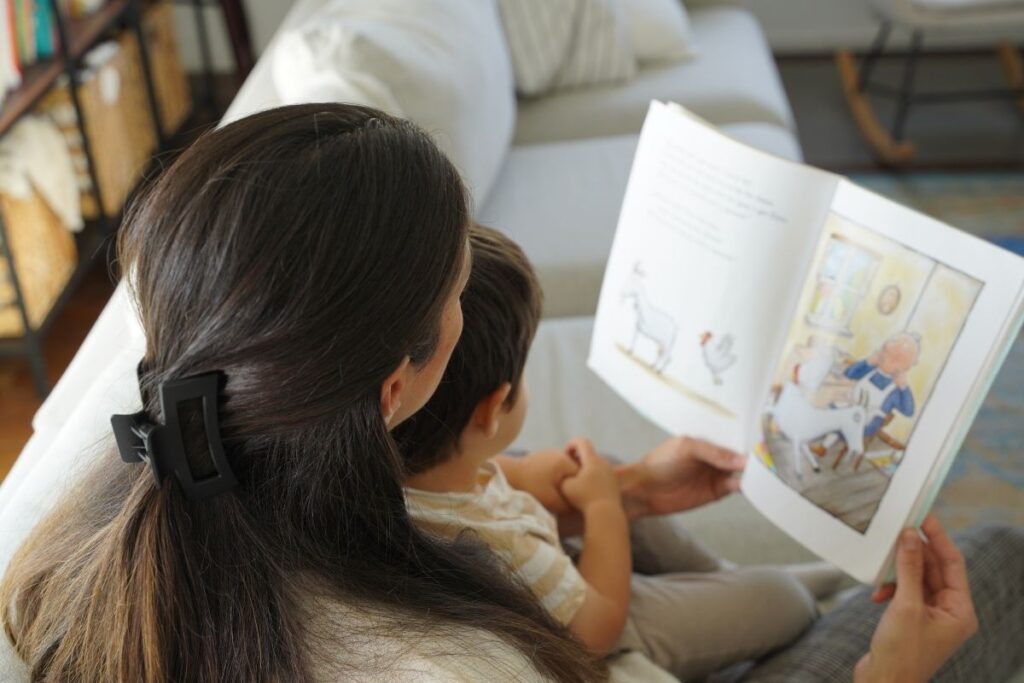
Presentation: Invite your child to sit with you and read a book together. Tell them the name of the author, the illustrator and the title of the book. Read clearly and with expression, without asking our child questions during the story.
Notes:
- We should read books every day. If we want our children to be inspired to read, they have to be read to.
- Choose books that have a quality story line and lovely illustrations. They should be true to life, interesting, relating to every day experiences, plants or animals. We want to help our child distinguish between what is real and what is not. Fantasy books, talking animals, etc., are not helpful for young children.
Book Recommendations:
- A Squash and a Squeeze by Julia Donaldson
- The Color of Your Skin by Desirée Acevedo
- Iggy Peck, Architect by Andrea Beaty
- Strega Nona by Tomie DePaola
- A Farmer Boy Birthday by Laura Ingalls Wilder
- Blueberries for Sal by Robert McCloskey
- Winter Days in the Big Woods by Laura Ingalls Wilder
- We’re Going on a Bear Hunt by Michael Rosen and Helen Oxenbury
- The Snowy Day by Ezra Jack Keats
- The Mitten by Jan Brett
Conclusion
I hope you got some good ideas of what things you can do at home to develop your child’s vocabulary and language skills! These activities are so simple yet very engaging and effective. I really hope you will implement some of them (if not all!) and witness how powerful in retaining information your child’s brain is at this stage of life!
Affiliate Disclaimer: Some links on this site are affiliate links. If you make a purchase, I may earn a small commission at no extra cost to you. As an Amazon Associate, I earn from qualifying purchases. I only share products I truly recommend.
