
Learning Through Senses: 5 Montessori Sensorial Activities Children Love
Our senses are the way our children learn and understand the world around them. These 5 Sensorial activities give them the chance to focus on each sense in isolation, helping them notice details they might otherwise overlook — the roughness of a texture, the softness of a sound, the brightness of a color. These hands-on lessons don’t just build sensory awareness; they also lay the foundation for concentration, order, and joyful discovery. In this blog I will show you how to make them and teach them to your child!
Target ages: 3 – 5
| Table of Contents |
| What is the Montessori Method? The Sensorial Area in Montessori The purpose of the Sensorial Materials 5-Montessori-Sensorial-Activities-Children-Love Conclusion |
What is the Montessori Method?
The Montessori Method follows the child’s interests and needs. Maria Montessori created different areas in the classroom (Practical Life, Sensorial, Math and Language) with specific materials to teach children different skills that will help them in their everyday life.
If you think about a normal school, you would probably imagine a big chalkboard on the wall and all of the students sitting at their desk looking at the teacher. In a Montessori classroom this looks very different. The main difference between a Montessori school and a traditional one is that the teachers give one-on-one lessons, or very small group lessons, and follow the interest of each child. Individual lessons are a great way for teachers to get to know the children and their needs. We use tangible materials that are built to teach specific skills, perfect to catch the attention of the little ones since they are using their hands. Maria Montessori once said: “Movement of the hand is essential. Little children revealed that the development of the mind is stimulated by the movement of the hands. The hand is the instrument of the intelligence”.
In the Montessori classroom, children are also allowed to walk freely in their environment and choose the work they want to do that has been previously presented by the teacher. Seeing children walking around the classroom like this can look a little messy at times, but I like to call it “organized chaos”. Children have a lot of freedom but within set boundaries.
The Montessori Method has been such a big eye opener for me in the way I want to teach and educate my children. I hope it inspires you too!
The Sensorial Area in Montessori
From the moment we are born, we begin to explore the world through our senses. The Sensorial Area in Montessori education was developed from the child’s natural need to touch, manipulate, and discover through hands-on experiences. Maria Montessori designed a unique set of materials that allow children to learn through sight, hearing, smell, taste, and touch — helping them make sense of the world in a concrete and meaningful way.
One of the most special aspects of the Montessori sensorial materials is the isolation of quality. Each material is designed to help children focus their attention on a single characteristic by eliminating all other distractions. For example, the color tablets are identical in size and shape, with matching white frames — the only difference is the color. This clarity allows children to truly refine their visual sense and make precise comparisons. Another remarkable feature of sensorial materials is the built-in control of error, which allows children to recognize and correct their own mistakes without needing adult intervention. This not only fosters independence but also encourages problem-solving and confidence in their own abilities.
Through sensorial exploration, children refine their senses and develop a deeper awareness of their surroundings. These early experiences not only support cognitive growth but also nurture independence, concentration, and a lifelong curiosity of the world.
The Purpose of the Sensorial Materials
Maria Montessori designed Sensorial Materials to help children refine their senses and develop essential cognitive skills:
- Classification of Impressions: As children work with sensorial materials, they start classifying and categorizing all the impressions they received. This enables them to make sense of their environment.
- Recall of Precise Qualities: Sensorial materials present abstract qualities in a concrete way, helping children to make an image in their mind when those characteristics are not present anymore.
- An Orderly Mind: In nearly all the sensorial materials, children need to put back in order pieces of the work that have been mixed up. This brings order to the chaos of impressions in their mind.
- Development of an Aesthetic Sense: Exposure to colors, shapes and textures cultivates an appreciation for beauty.
- Indirect Preparation: These activities naturally prepare children for reading, writing, math, and problem-solving.
5 Montessori Sensorial Activities Children Love
These next 5 Montessori Sensorial activities are sorted by sense so that your child can focus on one at a time. They are great activities for them to explore and learn through their senses.
SIGHT: Color Tablets

Bring color to life with Montessori color tablets! Your child will start simply by matching the same colors, and then move on to grade shades from dark to light. It’s a calm, beautiful way to explore color and pattern. Here you can download the three different boxes and start teaching your child today!
What you’ll need: You can make the Color Tablets by cutting small colored cardboard cards yourself or by downloading and laminating these ready-made templates here.
How to use it: We normally have three different boxes:
- Box 1 (primary colors): Mix the tablets and have you child match each color, placing each tablet one next to the other.
- Box 2 (primary and secondary colors): Same as in Box 1.
- Box 3 (a full color spectrum for grading shades): Choose one color from all the spectrum; mix the tablets and have your child grade them from dark to light. When they had a lot of practice, you can encourage them to grade all of the colors and place them around a yellow circle creating “sun rays”.
Why it’s great: Color tablets sharpen your child’s visual sense, support creativity, and encourage attention to detail. It is also a great way to teach the name of the colors to your young child!
HEARING: Sound Cylinders

Invite your child to become a little sound detective! Montessori sound cylinders are small containers filled with materials like dry beans, lentils or sand. When your child shakes each one, they’ll listen closely to find matching pairs by sound.
What you’ll need:
- Materials:
- Eight small containers (like spice jars or small bottles). It is important the containers are not see through so that the children can’t see what’s inside.
- Four different dry materials, for example: beans, lentils, chia/sesame seeds and sand.
- Fill the containers: Put one material in each container. You should end up with two containers for each material, giving you two identical sets of four.
- Secure the lids: Make sure all lids are tightly closed. You can tape or glue them shut for extra safety.
How to use it:
- Match the sound: Place each set of bottles on opposite sides of the table. Invite your child to shake each container, one by one, and listen carefully to the sound. Then, match the pairs by ear placing them together — the two containers with the same material make the same sound.
- Grade one set: Using only one set of containers, ask your child to grade the sounds from the loudest to the softest.
Why it’s great: This simple activity builds focus and helps children notice subtle differences in sound.
SMELL: Smelling Bottles

This activity turns scent into a fun guessing game! Fill small bottles or jars with familiar smells — think lemon, cinnamon, vanilla, lavender — and have your child match the pairs or identify each scent.
What you’ll need:
- Materials:
- Eight small containers, like spice jars (you want something that has holes on the top).
- Cotton balls
- Four different smells, for example: lemon, vanilla extract, cinnamon, lavender essential oil.
- Fill the containers: Put a few drops of each essence in a cotton ball and place them in each container. You should end up with two containers for each smell, giving you two identical sets of four.
How to use it: Place each set of bottles on opposite sides of the table. Invite your child to smell each container, one by one, and find the matching smell.
Why it’s great: Smelling bottles refine your child’s sense of smell and introduce new descriptive language (“spicy,” “sweet,” “fresh”). Plus, kids love discovering which scents they enjoy most!
TASTE: Tasting Bottles

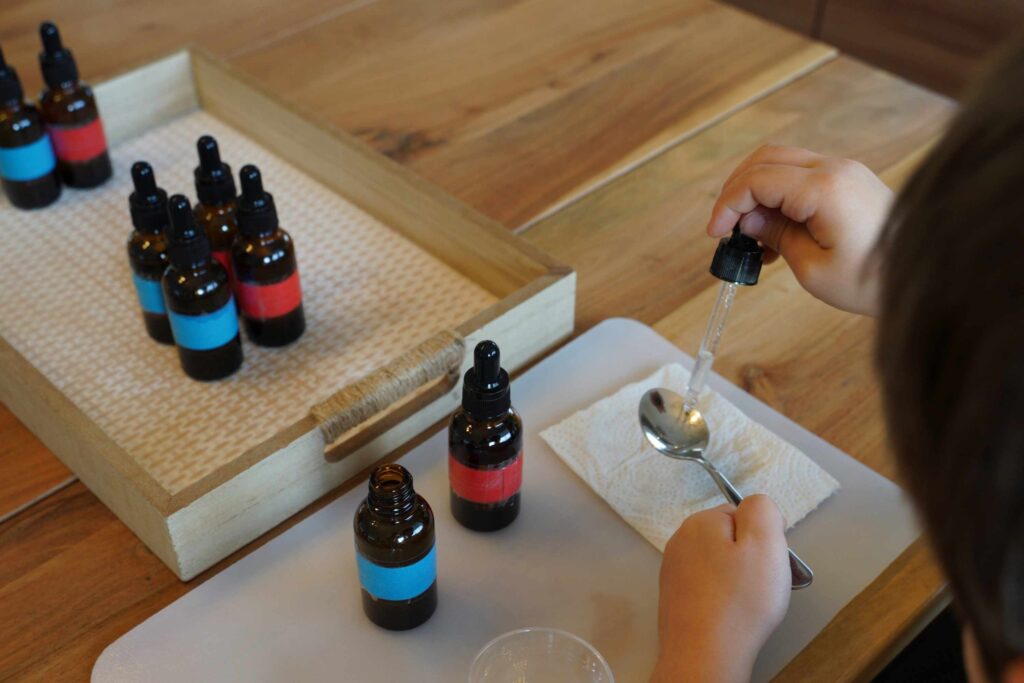
A delicious way to explore the sense of taste. With this activity, your child will explore the four different basic tastes: sweet, salty, sour, and bitter.
What you’ll need:
- Materials:
- Eight small dropper bottles (amber glass is a great choice because it’s opaque).
- Two small cups with water.
- A small spoon.
- A napkin.
- Prepare the taste solutions: Sweet (water and sugar), salty (water and salt), sour (water and lemon juice), and bitter (water and grapefruit rind).
- Fill the containers: Fill up the bottles with each solution. You should end up with two bottles for each taste, giving you two identical sets of four.
How to use it: Place each set of bottles on opposite sides of the table. Show your child how to take one bottle, put a few drops of the solution onto the spoon, and taste it while keeping a neutral expression. Then, choose a bottle from the other set and taste it to find the matching flavor. Once a match is found, clean the spoon in one cup and use the second cup to rinse your mouth before moving on to the next pair of tastes.
Why it’s great: Tasting bottles help children notice and name different flavors, encouraging sensory awareness.
TOUCH: Fabric Boxes

The Fabric Boxes activity invites children to explore and match different fabric textures using their sense of touch. The box is filled with pairs of small rectangular fabric made from materials like silk, cotton, velvet, wool, and burlap. Children feel each piece and try to find its match — sometimes even with their eyes closed for an extra sensory challenge!
What you’ll need:
- Materials:
- Five different fabric materials.
- One box or basket.
- A blindfold.
- Prepare the fabrics: Cut two equal rectangles of each fabric. In total, you’ll end up with ten fabric pieces (five pairs of matching textures). Place each set of fabrics into a box or basket.
How to use it: Place the box with the two sets of fabrics on the table and take out only one set. Show your child how to feel one set of fabrics by closing your eyes and touching each piece carefully with your hands and fingers. As you feel them, place them one by one in a line on the table. Then, bring out the second set of fabrics and put on the blindfold. Explain that you are going to match the fabrics by touch. Take one fabric from the second set, feel its texture, and compare it to the ones on the table until you find the match. When you find it, place the two matching fabrics together, one on top of the other. Continue until all the fabrics are paired. When you’re done, remove the blindfold and check your matches. Finally, invite your child to try the activity.
Why it’s great: This simple yet fascinating activity refines your child’s sense of touch, strengthens concentration, and encourages rich sensory language (words like smooth, rough, fuzzy, or silky). It’s also a lovely, calming way to slow down and notice the beauty in everyday materials.
Conclusion
The best part about these sensorial activities is that they naturally blend into daily life. You don’t need special materials to nurture your child’s senses, just a little intention and curiosity. Smell the herbs while cooking, match sounds on a walk, notice shades of color in nature, or describe how different fabrics feel.
By slowing down and exploring the world together, you’re helping your child build a deeper connection with their environment, one sense at a time. That’s the heart of Montessori: learning through living, discovering through doing, and finding joy in the small details that make our world so rich.
Affiliate Disclaimer: Some links on this site are affiliate links. If you make a purchase, I may earn a small commission at no extra cost to you. As an Amazon Associate, I earn from qualifying purchases. I only share products I truly recommend.
