
5 Easy Montessori Practical Life Activities for 2-Year-Olds
These five easy and affordable Montessori Practical Life activities are perfect for little hands to explore, create, and learn — all with materials you probably already have at home! Each activity helps children build independence, confidence and concentration while having fun with real-life tasks they can do themselves. These activities are especially well suited for toddlers in the later part of their second year (around 2.5 years old) or for confident 2-year-olds who are ready for more advanced hands-on work.
Target ages: 2 years old

What is the Montessori Method?
The Montessori Method follows the child’s interests and needs. Maria Montessori created different areas in the classroom (Practical Life, Sensorial, Math and Language) with specific materials to teach children different skills that will help them in their everyday life.
If you think about a normal school, you would probably imagine a big chalkboard on the wall and all of the students sitting at their desk looking at the teacher. In a Montessori classroom this looks very different. The main difference between a Montessori school and a traditional one is that the teachers give one-on-one lessons, or very small group lessons, and follow the interest of each child. Individual lessons are a great way for teachers to get to know the children and their needs. We use tangible materials that are built to teach specific skills, perfect to catch the attention of the little ones since they are using their hands. Maria Montessori once said: “Movement of the hand is essential. Little children revealed that the development of the mind is stimulated by the movement of the hands. The hand is the instrument of the intelligence”.
In the Montessori classroom, children are also allowed to walk freely in their environment and choose the work they want to do that has been previously presented by the teacher. Seeing children walking around the classroom like this can look a little messy at times, but I like to call it “organized chaos”. Children have a lot of freedom but within set boundaries.
The Montessori Method has been such a big eye opener for me in the way I want to teach and educate my children. I hope it inspires you too!
What is the Practical Life Area in Montessori?
Practical Life is an area in the Montessori curriculum where the children learn daily life skills that helps them become more independent, gain confidence and develop fine and gross motor skills.
When Maria Montessori started her educational career, she put a lot of emphasis on children’s hygiene and on different activities that encourage their independence. This is where the area of Practical Life was born. These activities are normally the first ones we introduce to children. They all have very specific goals. Maria Montessori summarized the purposes of the Practical Life activities like this:
- Independence: The goal of these activities is to help children develop the life skills necessaries to succeed in the world.
- Concentration: Children are drawn to Practical Life activities. This makes them want to repeat them over and over again. Repetition promotes concentration, which is very important for their development.
- Coordination of Movement: With these exercises the children practice fine and gross motor skills. At the same time, they gain coordination and refinement of their movements.
- Order: Every Practical Life activity follows a sequence of steps that the children need to follow. When we show these activities to our children it is very important to practice them before so that we know exactly what movements we are going to do what steps we are going to follow. This helps children with their Sensitive Period for Order that they are experiencing at this stage of their lives.
- Adaptation: Practical Life exercises are specific to each child’s culture. Some activities in Europe may look a bit different from others in Asia (for example: learning how to use cutlery). We also use real child’s size objects (like the ones they see in their house), not toys. This helps children adapt to their environment and learn how to interact with it.
- Supports development of the Will: Practical Life activities help children to develop self-discipline and self-control.
Considerations When Making Your Own Montessori Materials at Home
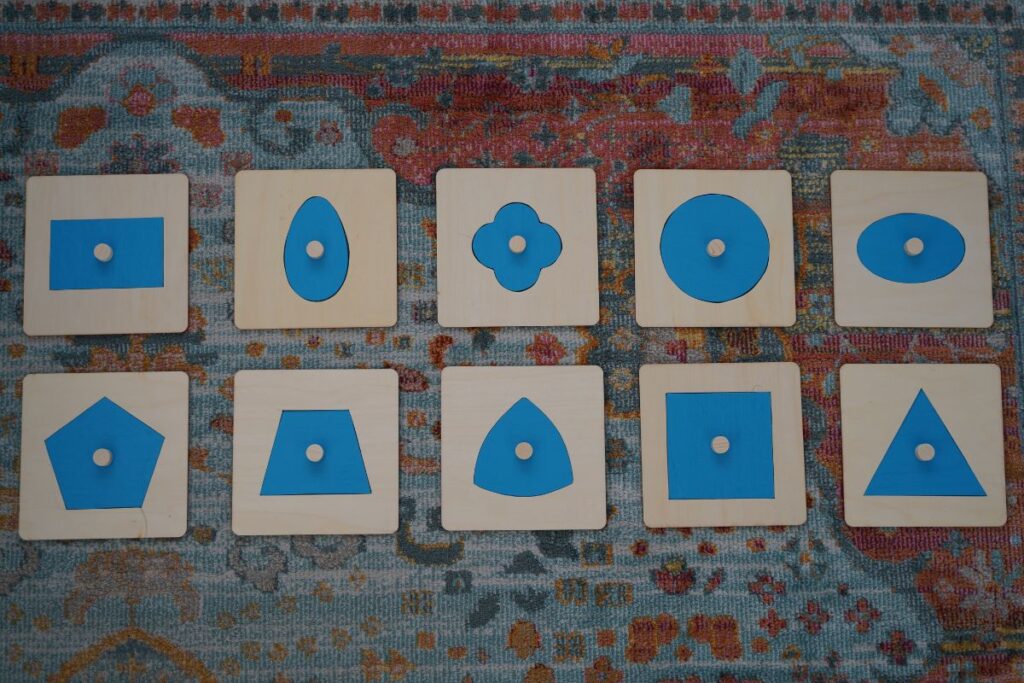
As a mom and Montessori teacher, there is nothing that I love more than teaching my own children the different Montessori lessons that I used to teach in the classroom! But because Montessori materials are so expensive, I had to come up with different ideas to make them myself. My goal is to save you time and money, whether you’re a parent or a teacher, and equip you with the resources and knowledge to help your children thrive in any learning environment!
There are a few things to consider when making your own Montessori materials at home. Maria Montessori taught they should be:
- Color Coded: When possible, make sure the objects in the activity are presented with the same color. This helps children with their own mental order.
- Child’s Size: Use real objects that are also size appropriate for your child’s little hands.
- Attractive: Children (and adults) are drawn to beautiful things. Make your activities beautiful by keeping them simple, clean, color coded and using real objects.
- Progression of Difficulty: The activities should follow others that get progressively more challenging.
- Separation: Keep the materials for each individual activity in a separate container or tray.
- Rotation: Change up the activity from time to time to keep it interesting! You can make different variations of it or change the objects (for example: use different types of pitchers or spoons) to keep children coming back to it.
- Open Ended: These activities don’t have an end which means children can work with them over and over again. This fosters their concentration and sense of achievement.
5 Practical Life Montessori Activities
These five Montessori activities help young children develop independence, practical skills and the ability to focus on purposeful work. They are simple, engaging and perfect for little hands to explore.
Opening and Closing Boxes
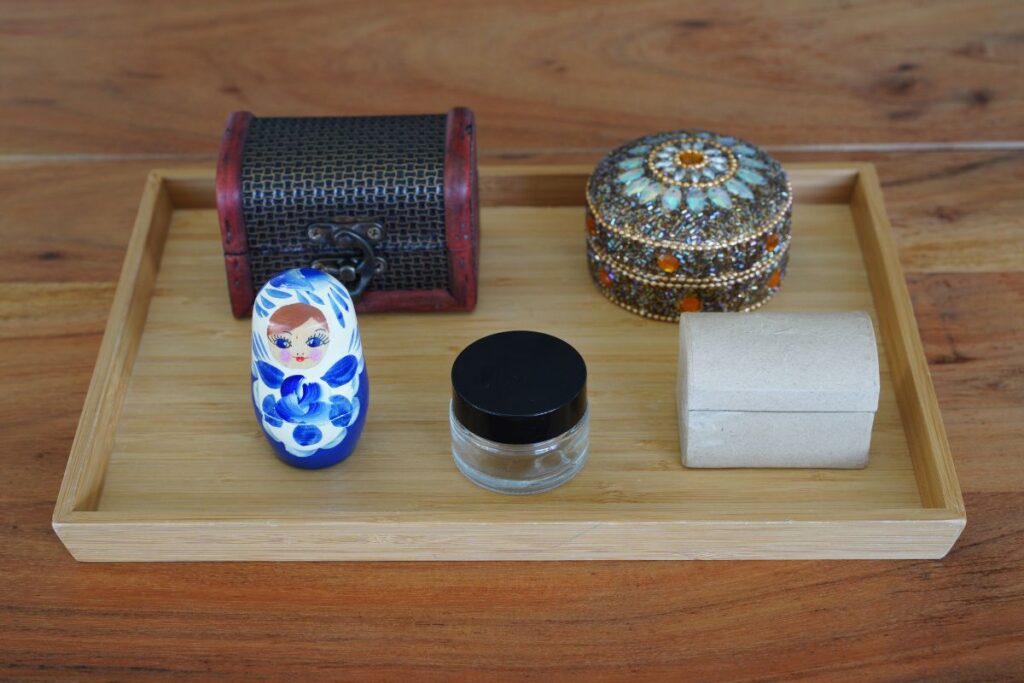
Materials:
- 4 – 5 boxes with different openings
- A tray
Presentation:
- Introduce the activity to your child: “I’m going to show you how to open and close the boxes. Can you bring the tray to the table?”
- Sit next to your child and place the tray in front of them.
- Begin the activity by saying: “I am going to open the boxes.”
- Pick up one box and slowly open it using both hands.
- Place the lid on the left side of the table and the box on the right side. Pause briefly.
- Repeat with the remaining boxes.
- When all the boxes are open, say, “Now I am going to close the boxes.”
- Take one box and find its lid.
- Slowly place the lid back on the box and close it.
- Place the closed box back on the tray.
- Repeat with each box, moving slowly and quietly.
- Invite your child by saying, “Now you can open and close the boxes.”
- Step back and observe.
- When your child is finished, gently invite them to place the boxes back on the tray and return the tray to the shelf.
Following Exercises:
- Opening and closing boxes found in the home (snack containers, tissue boxes, small storage boxes)
Spooning
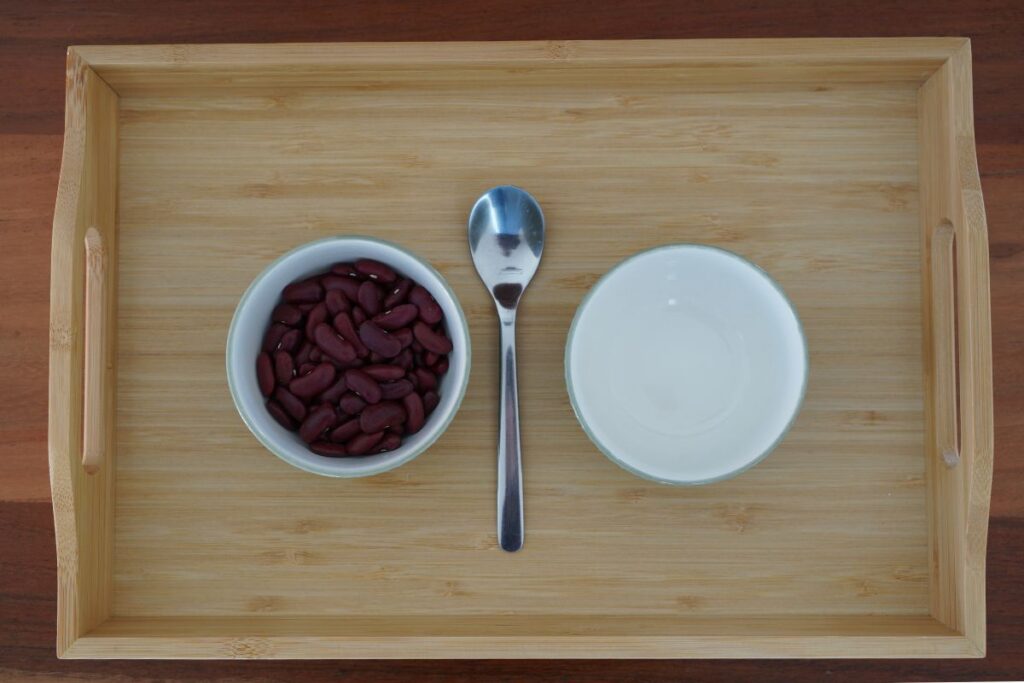
Materials:
- 2 small, identical bowls
- Dry beans or large legumes (one bowl partially filled, one empty)
- Small spoon
- Tray
Presentation:
- Introduce the activity to your child: “I’m going to show you the spooning work. Can you bring the tray to the table?”
- Sit next to your child and place the tray in front of them.
- Pick up the spoon and hold it still for a moment. Pause briefly so your child can observe.
- Holding the bowl, scoop a small amount of beans and carefully move the spoon to the bowl on the right.
- Release the beans over the center of the bowl.
- Continue spooning slowly until the left bowl is empty.
- Pause. Then hold the other bowl and spoon the beans back to the original bowl.
- Place the spoon back in the center of the tray.
- Invite your child to do the activity: “Now you can spoon the beans from one bowl to the other.”
- Step back and observe.
- If any beans spill, calmly pick them up and return them to the bowl.
- When your child is finished, gently invite them to place the tray back on the shelf.
Following Exercises:
- Using different spoons and containers
- Transferring other dry materials (chickpeas, lentils, rice)
Notes:
- This activity is an indirect preparation for writing. Your child practices moving from left to right and holding the spoon with a three-finger grip.
Dry Pouring
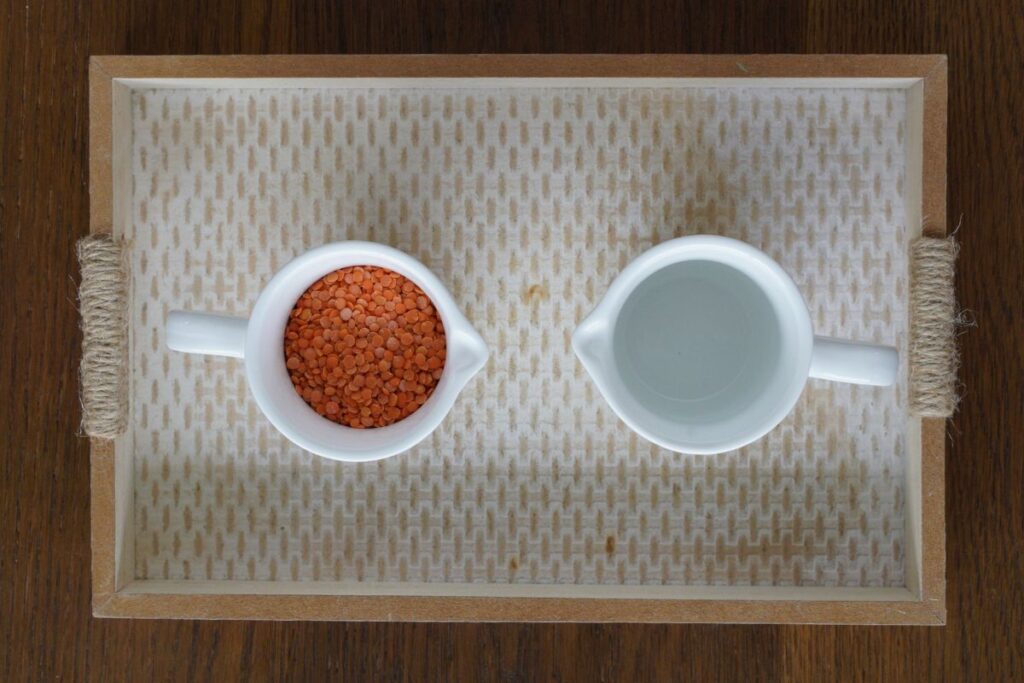
Materials:
- 2 small, identical pitchers
- Dry lentils or other small dry legumes (one pitcher partially filled, one empty)
- Tray
Presentation:
- Introduce the activity to your child: “I’m going to show you how to pour. Can you bring the tray to the table?”
- Sit next to your child and place the tray in front of them.
- Begin the activity and gently invite your child’s attention: “Watch.”
- Pick up the pitcher that has the lentils by the handle with one hand and support it with the other hand.
- Slowly pour the lentils into the center of the empty pitcher.
- Pause. Then pick up the other pitcher and pour the lentils back into the original pitcher.
- Invite your child to have a turn: “Now you can pour.”
- Step back and observe.
- If any lentils spill, calmly pick them up and return them to the pitcher.
- When your child is finished, gently invite them to place the tray back on the shelf.
Following Exercises:
- Pouring with cups instead of pitchers
- Pouring different dry materials
- Pouring water
- Suggest that they pour from a greater height
Learning to Get Dressed: Buttons, Snaps and Hooks
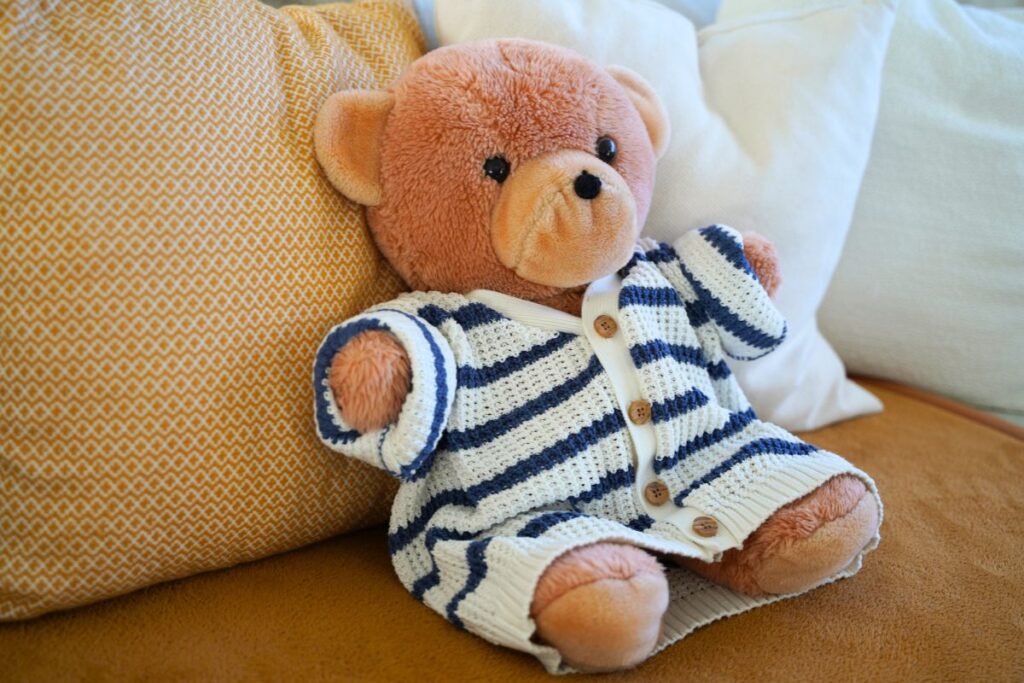
Materials:
- Teddy bear or doll
- Various clothing items with different fasteners (snaps, large buttons, small buttons, hooks and eye)
Presentation:
- Introduce the activity to your child: “I’m going to show you how to dress the bear.”
- Sit next to your child and place the dressed bear in front of them.
- Begin the activity and gently invite your child’s attention: “Watch.”
- Slowly unbutton the jacket from top to bottom. Pause briefly after each movement.
- When the clothing is open, say: “I unbutton the jacket. Now I am going to button it.”
- Slowly button the jacket, moving from top to bottom.
- Invite your child to have a turn: “Now you can try.”
- Step back and observe. Offer help only if needed.
Following Exercises:
- Encourage your child to dress themselves with simple clothing.
- Practicing with different fasteners
- Moving from larger fasteners to smaller ones as your child gains confidence
Notes:
- This activity is a great way to introduce new vocabulary, such as: button/unbutton, snap/unsnap, hook/unhook, fasten/unfasten.
Sweeping the Floor
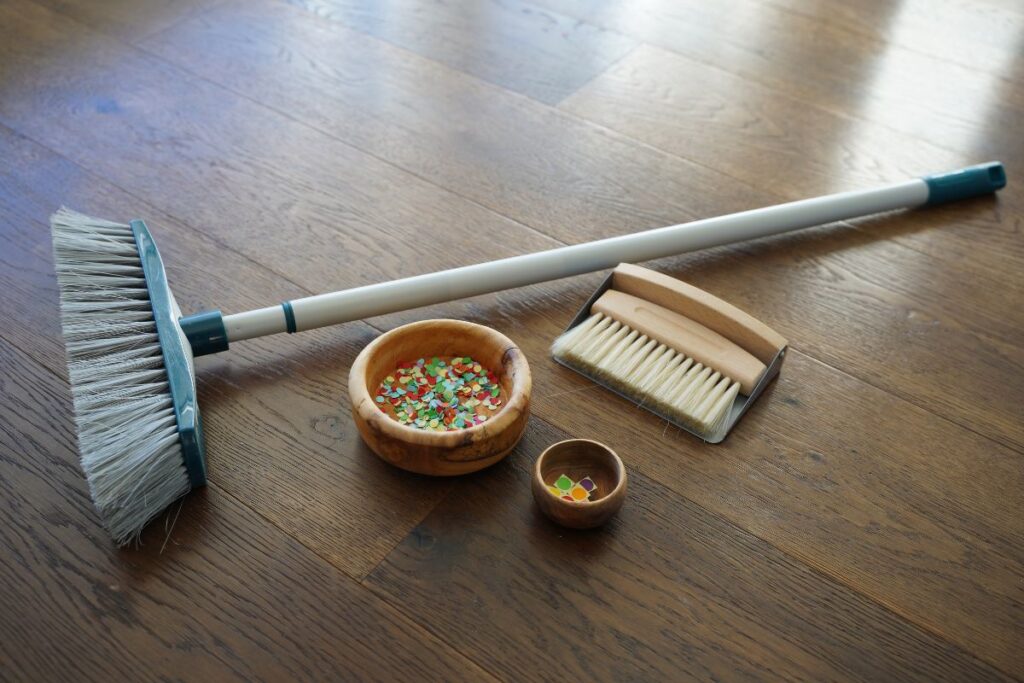
Materials:
- Child-sized broom (or a broom with a shortened handle)
- Dustpan and brush
- Small container with confetti, dried petals or small pieces of paper
- Small container with stickers
Presentation:
- Introduce the activity to your child: “I’m going to show you how to sweep the floor.”
- Place one sticker on the floor. Explain that this is where the dirt will go.
- Sprinkle a small amount of confetti near the sticker. Put the container away.
- Begin the activity by saying: “I am going to sweep the floor.”
- Show your child how to hold the broom. Move slowly and quietly.
- Sweep the confetti toward the sticker using short, gentle strokes.
- Put the broom aside.
- Take the dustpan and hand brush.
- Sweep the confetti into the dustpan.
- Throw the confetti into the trash.
- Put the dustpan and brush back in their place.
- Invite your child by saying: “Now you can sweep.”
- Step back and observe.
- When your child is finished, help them remove the sticker and throw it in the trash.
Following Exercises:
- Sweeping small, naturally occurring spills
- Learning how to safely sweep up broken glass or ceramic (with close adult supervision)
Notes:
- This same concept can be used for cleaning crumbs from a table. Use a small hand brush and dustpan, and place a sticker on the table as a visual guide to help your child gather the crumbs.
Conclusion
Practical Life activities are a wonderful way for children to build independence, concentration and confidence. The key is to present each activity calmly and with enthusiasm, showing your child that these tasks are meaningful and enjoyable. Gather your materials, invite your little one to join, and watch them explore, practice, and take pride in what they can do!
Affiliate Disclaimer: Some links on this site are affiliate links. If you make a purchase, I may earn a small commission at no extra cost to you. As an Amazon Associate, I earn from qualifying purchases. I only share products I truly recommend.
